
Contact Us
WhatsApp: +86 189 9002 2078
postmaster@langtingpergola.com

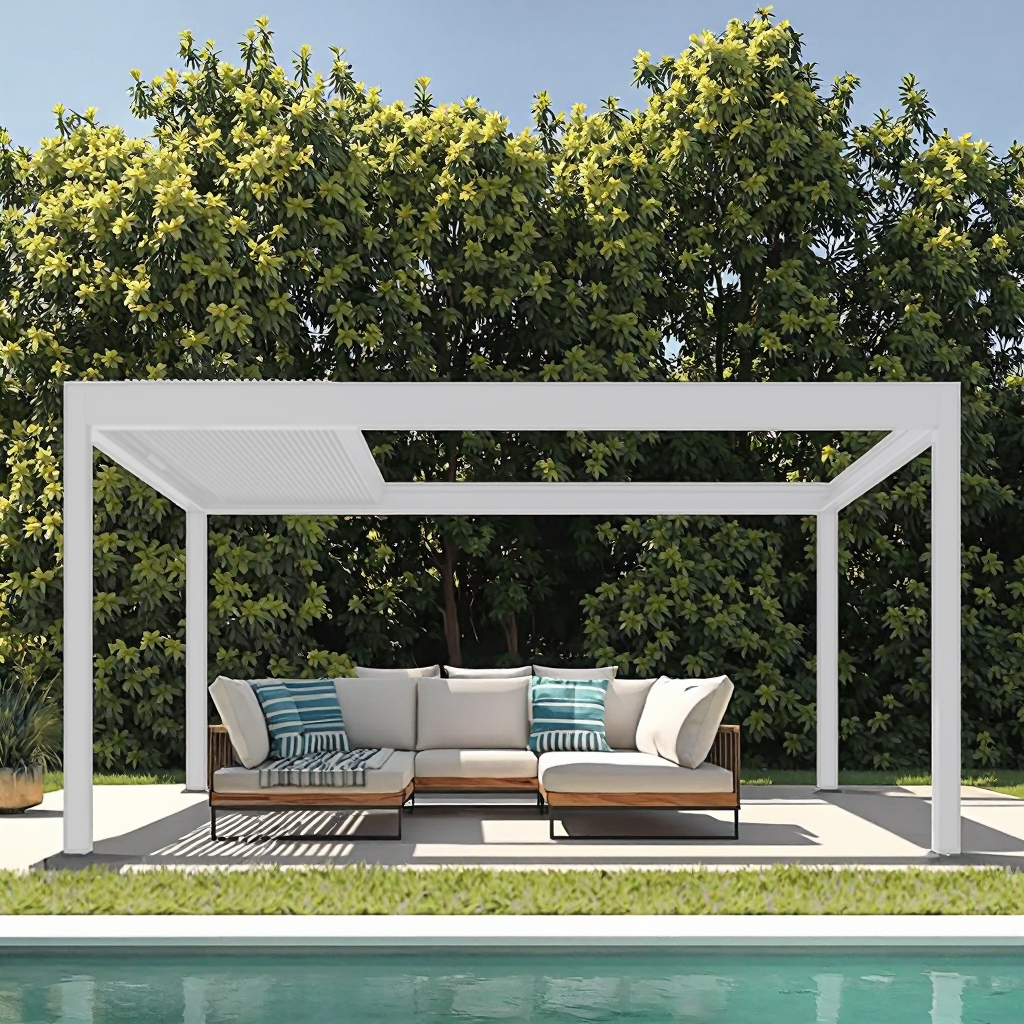
Two structures get compared more often than any other in outdoor living: a motorised pergola and a retractable awning. Both put a roof over a patio, both disappear when you do not want them, and both are sold by the same dealers. They are not alternatives, though — they do different jobs, and the right choice depends on whether you want shade on a roof that is always there or shade from a fabric that comes and goes.
This guide is written for the UK market, because that is where the questions we are asked most often come from: how much wind can a pergola withstand, what width retractable awning do I need for my patio, and which motor should be specified for an exposed site. We manufacture both — the driven louvre range is on our electric louvered pergola page, the awnings on our retractable awning page, and the side screens on our windproof roller blind page.
A motorised pergola is a permanent aluminium structure with a roof made of linked blades on a spindle. The blades rotate between closed and open, so the roof changes from a sealed canopy to an open lattice in about a minute. The frame stays there all year. It is a piece of architecture that happens to have a moving part.
A retractable awning is a fabric cassette mounted on a wall, on posts or on a stand, with an arm that extends a roller and pulls the fabric out to a set projection, then rolls it back into the cassette when you are finished. The cassette is small — usually 200 to 300 mm deep — and it can be fitted to a wall that already exists, which is why awnings are the first thing people add to a house they have already finished.
| Motorised pergola | Retractable awning | |
|---|---|---|
| Structure | Free-standing or wall-mounted aluminium frame, permanent | Cassette on a wall, posts or a freestanding frame |
| Cover | Aluminium louvre blades, waterproof when closed | Fabric or PVC, usually waterproof but not sealed |
| Shade when open | Partial — blades angle to filter light | Full — the fabric blocks the sun directly |
| Side protection | None as standard; can be combined with roller blinds | None as standard; can be combined with roller blinds |
| Night use | Structure remains; LEDs can be added | Cassette only; lighting is an accessory |
| Best for | Terraces, pools, exposed sites, restaurants, hotels | Existing walls, balconies, patios against a house |
This is the first question on nearly every enquiry, and the honest answer is that there is no single number. A pergola’s wind performance depends on the span, the section depth, the blade profile, the number of blades, the way it is fixed to the ground, and how exposed the site is. A closed louvred roof is a solid aluminium surface that catches the full wind load; an open louvred roof presents a much smaller area to the same wind. The rating has to be calculated for the specific configuration, not copied from a brochure.
The engineering behind the ratings — dynamic pressure, blade locking, frame sections and anchoring — is set out in full in our aluminium pergola wind rating guide. The short version for a buyer is that there are three things that actually protect the structure, and they work together:
Our wind-resistant electric louvered pergola and the large motorised aluminium pergola are the configurations we quote for exposed coastal and hilltop sites, and the insulated louvered pergola is the one that gets specified for city rooftops where the wind is channelled between buildings.
One point on awnings that is often misunderstood: an awning does not have a wind rating in the same sense. It has a wind class — Class 1 through Class 4 — which describes what the fabric and the frame will tolerate while the awning is extended. A good awning is designed to be extended to a defined limit and no further. Asking a supplier for the class rather than for a speed is the correct question, and the answer should be in the quotation.
The wind class covers three things at once: the fabric, the arm and the roller, and the fixing. A higher class means more reinforcement in the fabric, a stronger arm geometry, a stiffer roller tube and a bracket set that can take the reaction. In practice, Class 2 is a normal sheltered residential specification, Class 3 suits an open site or a coastal location, and Class 4 is a commercial or exposed specification.
The part that is usually missing from a conversation is the sensor. A motorised awning with a wind sensor retracts to the cassette when the wind crosses the threshold, and the threshold is set at commissioning to match the class and the site. Our auto wind sensor windproof roller blind uses the same automatic-response logic, and the principle is the same: the mechanism is faster than the weather, so the decision does not depend on anyone being present.
The size of an awning is described by its projection — how far it reaches out from the wall — and by its width along the wall. The projection is the number that decides how much of the patio is covered, and it is limited by three things: the arms, the wind class and the available wall.
The width along the wall then follows from the space. One common mistake is to order two narrow awnings to cover a wide terrace instead of one wide one. Two awnings means two cassettes, two end plates and two drop lines, and the seam between them becomes a line of shade that does not quite line up. If the wall can carry it, one wide awning is better in every practical way. Where the wall is short, our multi-point locking windproof roller blind and the larger awning sizes are specified to be combined with vertical side screens, which close the gaps properly.
Full detail on this is in our guide to specifying a retractable awning, which covers projection, fabric width, brackets and drive.
A pergola is sized on the space it has to cover, not on the size of the product. Two rules of thumb are useful when you are gathering quotations:
On spans, the practical division is the same as elsewhere in aluminium structures: up to about four metres is a standard configuration, beyond that the section depth and the wind rating start to matter, and beyond six metres the project needs a structural calculation rather than a catalogue dimension. Our electric louvered pergola page shows the standard configurations, and the large motorised aluminium pergola covers the wider spans that commercial terraces need.
Both product types are motorised, and both are controlled the same way once the hardware is chosen: a wall switch as the baseline, a handheld remote as the interface most people actually use, a mobile app for position feedback and scheduling, and a dry-contact or 0–10 V input for integration with a building management system or a home automation platform.
Two practical warnings apply to both. First, an app is a convenience, not a control method: if the site loses its connection, the structure still has to be operable from the local switch. Any system you buy should keep a hardwired or remote local channel working independently of the network. Second, if you are integrating with an existing automation system, say so before the order, because the interface has to be configured at commissioning rather than added afterwards.
The retractable awning with energy-efficient home automation and the app-controlled louvered pergola are the two configurations that cover this end of the range. The mechanism behind them is covered in detail in our electric pergola roof guide.
For vertical side screens — the blinds that close the open sides of a pergola or awning — the motor is less important than the guide system and the fabric tension. A blind on a windy site needs to be guided at the bottom rail as well as the top, otherwise it flutters and the fabric shakes itself apart at the edges. Multi-point locking, where the bottom rail is held in more than one channel, is what stops that.
On the motor itself, look for a unit with a stated wind-sensor input rather than a simple timer, because on an exposed site the decision to retract has to be automatic. A tubular motor with a sensor input and a defined threshold is the right specification. Our multi-point locking windproof roller blind and the motorised waterproof zip-track roller blind are built for that combination of guided bottom rail, fabric tension and sensor input.
A pergola and an awning are both low-consumption devices. The drive on a louvred roof is a linear actuator that runs while the roof is moving and does nothing else; a retractable awning motor is a tubular motor with a similar duty cycle. On a typical installation the drive is a trivial part of the electricity bill. On a pergola the meaningful energy load is the lighting and any infrared heaters added to the same structure, not the roof mechanism.
Maintenance is straightforward for both. For a louvred roof, clean the blade channels and the drainage path twice a year, check the linkage fixings on the same visit, and have the actuator inspected every second or third year. The gaskets, the control board and the actuator are the three items that will eventually need replacing, and all three are replaceable without taking the roof apart — which is the point to check before you order. For an awning, the fabric needs to be kept clean and free of debris, and the arms and brackets checked annually.
Material choice also changes the running cost, and it is worth comparing aluminium against steel before you commit. Our aluminium versus steel pergola comparison covers the corrosion and freight angle in detail; the short version is that aluminium needs no painting and no coating maintenance over its life, which is the difference that shows up in the ten-year cost of ownership.
There is no better system, only the better-matched one. The decisions are usually made on these lines:
Where you want the sun controlled rather than blocked, and you are not sure which way to go, note that the louvred roof is adjustable and the fabric awning is not. A blade that can sit at 45 degrees filters light without creating the dark, flat shadow that fabric produces, which is one of the reasons hotel and restaurant terraces have moved almost entirely to louvred roofs.
Both systems are relatively light compared with a glazed structure, but neither is a DIY job, and the site conditions decide the method.
Our patio and deck electric retractable awning and the commercial retractable awning are the two configurations that cover most of these cases, and both are specified with the mounting and the certification scope stated in the quotation.
It depends on the configuration rather than the product name, so there is no single number to quote. Span, section depth, blade profile, blade locking and the anchoring all contribute, and a closed louvred roof catches far more wind than an open one. The right question to ask a supplier is: what wind speed has this specific span and this specific base been calculated for, and can you see the calculation? Our pergola wind rating guide explains the method in full, including why anchoring usually matters more than buyers expect.
Not better — different. A pergola is a permanent structure with an adjustable aluminium roof, which means filtered light, a frame that can carry lighting and heaters, and a wind performance that can be engineered to a specific site. An awning is a fabric cassette that can be added to an existing wall quickly, gives full shade while extended, and costs less. If you have a wall and a modest budget, an awning is usually the better first move. If the terrace is open, exposed, or a commercial project where the structure has to look permanent, the pergola is the stronger answer.
Size it by projection, not by width along the wall. A projection of 2.5 to 3 metres covers a typical table and chairs with space around it; 3.5 to 4 metres covers a larger terrace or a poolside area. Then match the width to the wall, and prefer one wide awning over two narrow ones because two means two cassettes, two end plates and a seam in the shade. Above four metres of projection you are into commercial specification and the wind class becomes decisive.
Yes, and it is designed for it. A motorised awning with a wind sensor retracts automatically when the wind crosses the threshold set at commissioning, and it will do that faster than a person can react. What it is not designed for is a wind speed beyond its class — a Class 2 awning on an exposed site will still be damaged in a storm, which is why the class and the site exposure have to be specified together, and why an exposed location should specify a higher class with a sensor rather than a lower class with a timer.
Almost always, yes. The actuator, the controller and the sensors run on a low-voltage supply that comes from a mains-fed power supply, and in most UK installations the supply and its certification are installed by a qualified electrician. The alternative is a solar-powered roof with a battery, which is a genuine option on sites with no power or where running a cable would be disruptive, and it can be specified as a hybrid so that the roof still operates on a dark winter day. Either way, decide the power supply before the frame is on site, because it determines where the control box goes and how the cable is routed.
The motor matters less than the guide system. A blind on a windy site needs a guided bottom rail as well as a top rail, so that the fabric cannot flutter, and multi-point locking, where the bottom rail is held in more than one channel. On top of that, the motor should have a wind-sensor input and a defined threshold, so the blind retracts automatically rather than relying on somebody noticing. The fabric itself should be a tightly woven, coated or laminated material with minimal stretch, because stretched fabric flaps and fails at the edges first.
An awning is materially cheaper than a pergola, and the difference is structural rather than a matter of finish. A pergola is a permanent aluminium frame with a moving roof, and the cost sits in the section sizes, the blade mechanism, the actuator, the controls and the base. An awning is a cassette, an arm set and a fabric, fixed to a wall that already exists. The comparison that matters is not the purchase price but the ten-year cost: a pergola made from aluminium needs no coating system and no painting, while the fabric on an awning is a consumable that will need replacing at some point, and that replacement is the single biggest ongoing cost difference between the two.
A motorised pergola and a retractable awning answer the same question in two different ways. The pergola is architecture: a permanent aluminium structure whose roof filters light through blades and can be engineered for an exposed site. The awning is an addition: a compact cassette that turns an existing wall into shade in an afternoon. Both are good answers. The mistake is choosing one because it is called the other thing, or because a photograph of a sunroom looked similar.
Our motorised range is on the electric louvered pergola page and the retractable awning page, and the side screens that turn either of them into an enclosed space are on the windproof roller blind page. If you have drawings, a site location or an existing control system to integrate with, send the details to our team and we will quote against the actual specification, including the wind rating, the control scope and the fixing method. If you are weighing the glazed option as well, our aluminium sunroom, veranda and pavilion guide covers that side of the decision.

[…] and the wind rating. If you are still deciding between a glazed room and an open shelter, our motorised pergola versus retractable awning guide covers the open-air options in the same level of […]