Contact Us
WhatsApp: +86 189 9002 2078
postmaster@langtingpergola.com

What an aluminium pergola wind rating actually means, typical ratings by pergola type, whether a pergola can withstand a hurricane, and why anchoring decides everything.
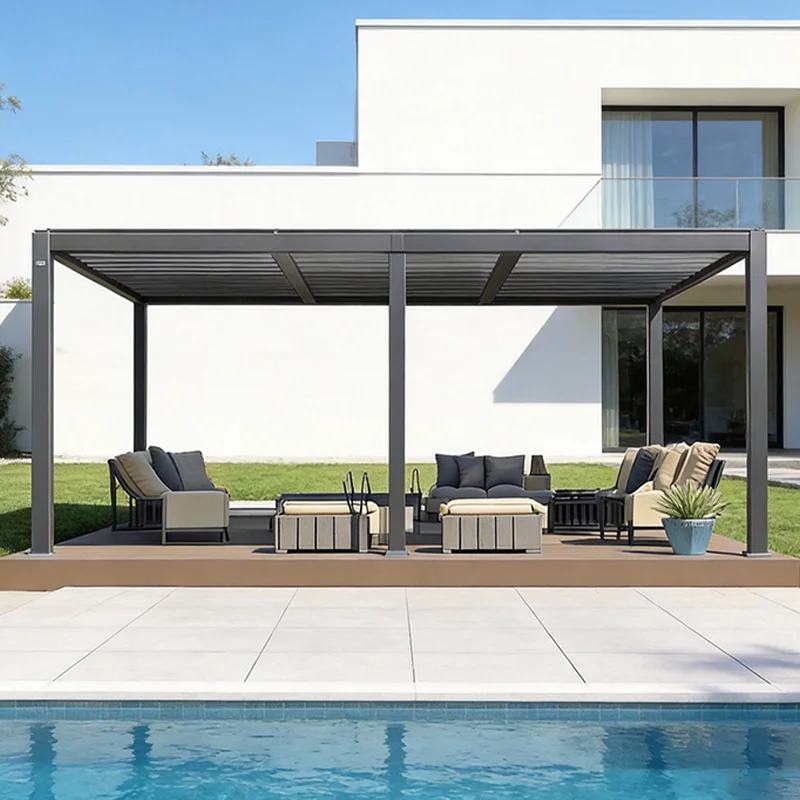
“How much wind can a pergola withstand?” is one of the first questions a serious buyer asks, and it is also one of the least clearly answered. A brochure might say 120 km/h; a test report might say 180 km/h; and a contractor might quote a figure that means something entirely different. The honest answer is that there is no single number, because a pergola’s wind capacity is a property of a complete system — frame, blades, fixings, footing and the way it is installed — rather than of the product alone.
For the wind-rated systems themselves, see the wind-resistant manual louvered pergola and the insulated motorised aluminium gazebo.
This guide sets out what an aluminium pergola wind rating actually means, what typical ratings look like by pergola type, whether a pergola can withstand a hurricane, whether it can survive one without anchoring, and how to specify a wind-rated structure for your own site. If you want the finished range first, our motorised gazebos and pergolas category includes the wind-rated systems, and our wind-resistant louvered pergola is the specific model built for exposed locations.
Before comparing numbers, it helps to know which of three different ratings you are looking at, because they differ by a factor of several.
Wind load also scales with the square of wind speed, so the numbers are not linear. Doubling the wind speed quadruples the pressure on the structure. A system rated at 120 km/h is not “twice as strong” as one rated at 60 km/h — it is roughly four times as strong. This is why a small difference in rating matters so much, and why a figure quoted without the test standard behind it is worth very little.
The table below reflects the ranges we see across properly engineered and properly anchored aluminium systems. It is a guide for comparison, not a specification: your own rating depends on span, height, exposure and the site the structure is fixed to.
| System | Survival rating when closed and anchored | Safe to leave open | Notes |
|---|---|---|---|
| Fixed aluminium pergola (no moving blades) | Typically 160–220 km/h | Same as survival | Acts as a solid canopy. Rating is set by the frame and the footings. |
| Manual louvered pergola | Typically 140–200 km/h | Close the roof well before the limit | Open blades act as an array of sails and load the frame several times higher. |
| Motorised louvered pergola with wind sensor | Typically 150–200 km/h | Automatic closure, typically 18–25 m/s | The sensor closes the roof before the structure reaches its limit. |
| Lean-to / wall-attached louvered pergola | Typically 130–180 km/h | Close early | One side is held by the building wall, so the load path differs. |
| Surface-mounted base plate, any type | Frequently well below 80 km/h | Not suitable for exposed sites | Uplift, not side load, is what removes a surface-mounted structure. |
The last row is the one that matters most in practice, and we return to it below.
Not in the sense most people mean. A pergola is a garden structure, not a shelter. It is designed to resist wind, not to protect you from it, and no reputable manufacturer will describe one as hurricane-proof. What a properly engineered and properly anchored aluminium pergola can do is survive being hit by the wind of a moderate storm without structural failure — which is exactly what you want from a structure worth a significant sum of money standing in your garden.
For scale, here is what a hurricane actually produces. Sustained winds in Category 1 run from 119 to 153 km/h, rising through Category 2 (154–177 km/h), Category 3 (178–208 km/h), Category 4 (209–251 km/h) and Category 5 (above 252 km/h). The gusts in a storm typically exceed the sustained figure by 30–50%, so a Category 1 hurricane routinely produces gusts above 180 km/h, and a Category 4 storm can gust beyond 300 km/h.
A closed, anchored, properly engineered louvered pergola rated at 160–200 km/h will usually come through a Category 1 storm with damage to finishes, gaskets and fixings rather than structural failure. A Category 3 or 4 hurricane is a different matter: at those loads the frame is being tested beyond almost any garden structure rating, and the honest expectation is damage or destruction unless the system has been specifically engineered and certified for it.
Two practical conclusions follow. First, if you live in a hurricane zone, the correct specification is a system with a published wind rating and test evidence, anchored into reinforced concrete, and closed before the storm arrives — a motorised roof with a wind sensor does that automatically. Second, and more importantly: you should not be under a pergola during a hurricane, whatever its rating. The rating protects your investment in the structure, not the people sitting under it. Our detailed look at what it takes for a louvered pergola to handle 120 km/h works through the engineering in more detail.
No. Not reliably, and not in a way any manufacturer will warrant. This is the single clearest answer in this guide.
The reason is that wind does not push a pergola over — it pulls it up. When wind passes over a roof, it creates suction on the upward face, and for a light aluminium structure with a large roof area, the uplift force can exceed the entire weight of the structure. A 20 kg pergola roof in a 150 km/h gale can see an upward load of several thousand kilograms. Surface-mounted base plates resist overturning by friction alone — the weight of the structure pressing on the plate. When the uplift exceeds that weight, the base plate simply lifts off the paving, and the whole structure goes with it.
The fix is proper anchoring: posts set into reinforced concrete footings with chemical or mechanical anchors sized for the calculated uplift force, with a minimum embedment depth set by the anchor manufacturer and confirmed against the local soil and concrete specification. The anchor type, the embedment, the concrete grade and the torque values are all part of the wind rating — none of them are optional extras.
If you already own a pergola and are unsure how it is fixed, the test is simple and immediate: if you can see the base plate sitting on top of the paving with a handful of expansion bolts, it is surface-mounted and it will not survive a serious storm. Get it re-anchored before you need it.
There are two ways a rating is produced, and you should ask which one you are being shown.
The structure is analysed against the wind loading code for the destination country — EN 1991-1-4 and its national annexes in Europe, ASCE 7 in the United States, GB 50009 in China — using the local basic wind speed, the terrain category, the exposure height, the shape coefficient of the roof and its porosity, and the calculated uplift on each fixing. The output is a design wind speed and a set of anchor forces. This is the method used for every project, and it is what your engineer relies on. It is sound, but it is only as good as the inputs, so ask for the wind speed and terrain category used, not just the final number.
A full-scale or representative section is mounted in a wind tunnel, or loaded statically until the structure fails, and the failure load is recorded. For roofs in hurricane-prone regions the reference point is a Miami-Dade Product Approval or an equivalent recognised certification, which applies the HVHZ (High Velocity Hurricane Zone) test protocols. Static load testing is faster and cheaper than wind tunnel work, and it is entirely valid for a straightforward louvered roof, provided the report names the standard and the accredited laboratory.
What to ask for: a report from an ISO/IEC 17025-accredited laboratory, the test standard named, the blade position tested (it must be closed), the anchoring configuration tested, and the alloy and temper used. A report that says “120 km/h” with none of that attached is not a rating.
Even a correctly rated system performs worse than its paper figure in several common situations, and a good supplier will tell you about these rather than sell you a number.
Corrosion is a related issue in coastal and tropical markets. Our aluminium versus steel comparison for coastal and tropical markets covers the material choice and the specification changes that chloride exposure demands.
Put these seven items in writing on the order, and any supplier who cannot answer all seven is telling you something useful.
A properly engineered, properly anchored aluminium pergola with a closed and locked louvered roof typically survives between 140 and 220 km/h depending on span, height and profile. With the blades open, treat that figure as irrelevant — the roof should be closed well before the wind reaches a serious level. Any specific number for your site has to come from a calculation or a test report against your local wind code, because the design wind speed at your location and the exposure of your site can easily halve the effective figure.
It can survive the wind of a low-category hurricane without structural collapse if it is engineered, anchored and closed properly, but it is not a hurricane shelter and should never be occupied during one. In a Category 3 storm or above, expect damage or destruction of any garden structure that has not been specifically certified for that load. The purpose of a pergola rating is to protect the structure and the property around it, not to make it safe to sit under during a storm.
No. Surface-mounted pergolas are held down by their own weight, and in a hurricane the upward suction on the roof routinely exceeds that weight, so the base plates lift and the structure is removed from the site. If a pergola is currently sitting on paving on surface-mounted plates, treat it as being at high risk in any severe storm and get it properly anchored into footings — or take it down and store it before the season.
Choose the design wind speed for your location from the local code, then select a system whose rated survival speed sits above it with a sensible margin — and make sure the anchoring is designed to match. In practice, for most of the UK, Western and Central Europe, the Middle East and much of Asia, a properly anchored aluminium pergola rated in the 140–200 km/h range with a wind sensor on a motorised roof covers the requirement comfortably. Coastal, tropical and high-rise rooftop sites need the calculation done properly rather than read off a brochure.
Yes, on a motorised system with a wind sensor fitted. The sensor measures wind speed at the structure and closes the roof when it crosses the set threshold, usually somewhere between 18 and 25 m/s. The threshold has to be tuned to the site and the structure’s own rating — set too low and the roof closes constantly; set too high and it closes after the load has already risen. A manual system cannot do this, which is a genuine practical argument for motorised roofs in exposed locations.
Snow is a separate calculation from wind and is not covered by a wind rating. A flat or gently pitched aluminium roof will accumulate snow, and the load depends on your local ground-level snow figure and the roof pitch. If you are specifying in a climate with regular snowfall, raise it explicitly with the supplier, because a standard pergola is not designed for snow accumulation by default and the fix — a steeper pitch, a heating cable, or a higher-rated frame — has to be decided before fabrication.
An aluminum pergola wind rating is the speed the structure survives when it is closed and locked — 140 to 220 km/h across the properly engineered and anchored systems we supply. The wind class is the wider classification used in the load calculation, which sets the design pressure for the site rather than for the product. The two are read together: the wind class says what the code requires at your location, and the rating says what this specific assembly holds. We use aluminium throughout our own documentation, but the rating is a speed in km/h and is identical whichever spelling you use to look it up.
The question “how much wind can a pergola withstand?” has a good answer, but it is always conditional: this system, this span, this site, this anchoring, this blade position. A supplier who gives you a single unconditional number is selling you a brochure. A supplier who gives you the calculation basis, the alloy, the blade locking, the sensor logic, the anchoring detail and the test report is giving you a structure you can specify, insure and rely on. In a market where the difference between those two conversations is the difference between a pergola that survives the season and one that does not, ask the second set of questions.
Our wind-rated systems are on the motorised gazebos and pergolas page, and the insulated motorised gazebo for wind-rated all-season use is built for exactly this specification. Send us your site location and the design wind speed you need, check our procurement information, and contact our team — we will quote against the actual standard, not against a generic figure.