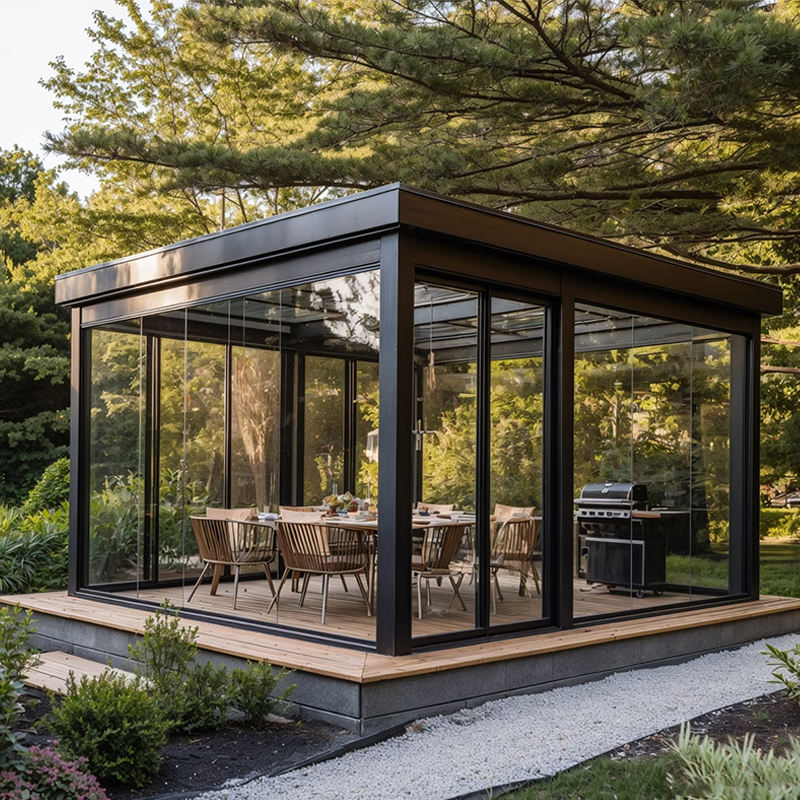
Five years ago, a premium pergola meant beautiful wood or powder-coated aluminum — manually operated. Today, that is table stakes. The 2026 outdoor living market has decisively shifted to motorized louvered pergolas as the default choice in mid- to high-end projects.
What is driving the change, and what does it mean for dealers, architects, and property developers? The global outdoor living market is projected to exceed USD 60 billion by 2027, with motorized louvered systems growing at a CAGR of 8 to 10 percent — roughly double the rate of fixed pergolas.
Three Forces Driving the Shift
- Smart home adoption. Consumers who invested in app-controlled lighting, blinds, and HVAC now expect the same control over their outdoor shading. The manual crank feels dated in a smart-home context.
- Climate adaptation. More frequent heat waves and unpredictable rain patterns make adaptive shading a practical necessity, not a luxury.
- Hospitality competition. Hotels and resorts that offer year-round usable outdoor space win more bookings. Motorized systems extend the usable season by months.
What a Genuinely Modern Motorized System Ships With
The category has matured well beyond the early products.
- Dual-motor drive with overload protection (each motor handles about 50 percent load, so a single failure will not leave the roof stuck open).
- Brushless DC motors for silent operation (under 40 dB).
- Smartphone app control (iOS plus Android) plus RF remote backup.
- Weather sensor integration (rain, wind, sun).
- Voice control via Alexa, Google Home, Apple HomeKit.
- Auto-return-to-position memory after power cycles.
If a quote you are reviewing does not include these features, you are looking at a generation-1 product — and the price gap to a current-generation unit is usually under 10 percent.
The B2B Case for Stocking Motorized
For B2B buyers, the math is shifting decisively in favor of stocking motorized:
- Average ticket size for motorized projects is 40 to 60 percent higher than manual.
- Installation labor is comparable (most modern systems pre-wire at the factory).
- Service revenue is stronger — annual maintenance contracts are easier to sell on motorized systems.
- Customer satisfaction is higher because clients use the system more often.
The old concern — motorized is too complex — is fading as factory pre-wiring, plug-and-play control boxes, and pre-flashed firmware have eliminated the on-site configuration that used to require an electrician.
What to Plan for on Site
If you are bidding on a 2026 motorized pergola project, factor these into your quote:
- Dedicated 220V or 110V circuit depending on region (check motor spec sheet — newer 24V DC systems can sometimes run on a low-voltage transformer).
- Conduit path between motor column and control box, ideally pre-planned during hardscape work.
- Wi-Fi signal at the install location (or specify RF remote plus dry-contact control as backup).
- Drainage for rainwater management — when louvers close during rain, water flows through integrated channels to downspouts inside the columns.
- Access panel for future service on the motor and control box.
A well-planned install looks invisible. A poorly-planned one ends up with exposed cables or, worse, a client who cannot open their roof because the Wi-Fi is too weak at the patio.
What’s Coming in the Next 12–18 Months
- Solar-assisted motors for off-grid installations.
- AI-driven climate adaptation (system learns the homeowner preferences over time).
- Native Matter and Thread support to avoid deeper smart home integration.
- Lightweight carbon-fiber reinforced blades for larger spans without heavier frames.
Bottom Line
Motorized louvered pergolas are no longer an upsell — they are the default. If your business is still quoting manual systems as the standard, you are losing deals to competitors who spec motorized as the starting point and offer manual only when budget is constrained. The 2026 outdoor living market is being built around adaptive, app-controlled outdoor spaces. Make sure your catalog reflects that.